

Blackjack stands as one of the most popular card games in casinos worldwide, combining elements of skill and chance in a way that attracts both beginners and experienced players. The goal is simple: get your cards to total as close to 21 as possible without going over, while beating the dealer’s hand. This straightforward concept makes blackjack easy to learn but challenging to master.
Unlike many casino games that rely purely on luck, blackjack offers players the opportunity to influence their odds through strategic decision-making. Players must decide when to take additional cards, when to stand with their current total, and when to employ advanced tactics like splitting pairs or doubling down. These choices can significantly impact the outcome of each hand.
Whether someone plays online for free or at a physical casino table, understanding the basic rules and strategies can transform blackjack from a game of pure chance into an engaging battle of wits against the dealer. The game’s rich history, mathematical foundations, and social aspects have made it a cornerstone of gambling culture for generations.

What Is Blackjack?
Blackjack is a casino card game where players try to beat the dealer by getting cards that add up to 21 or as close as possible without going over. The game started in France and became popular worldwide with many different versions.
History of Blackjack
The game began in French casinos around the 1700s. It was called “vingt-et-un,” which means “twenty-one” in French.
French colonists brought the game to North America. American casinos added special bonus payouts to attract more players. One bonus paid extra if a player got the ace of spades and a black jack (either the jack of clubs or jack of spades).
This special hand gave the game its name “blackjack.” The bonus rule was later removed, but the name stuck.
Key early names for the game:
- Vingt-et-un (French)
- Twenty-one (English)
- Ventiuna (Spanish)
The modern rules developed during the 1800s and 1900s. Casinos standardized the basic gameplay that players know today.
Blackjack Around the World
Blackjack is now the most played casino card game worldwide. Each region has developed its own style and rules.
In Britain, the game is called pontoon. This version became popular after World War I. British pontoon uses slightly different rules than American blackjack.
European casinos often use the “European blackjack” style. The dealer gets only one card face up at the start. They don’t check for blackjack until after players finish their hands.
Regional variations include:
- Australia: Uses pontoon rules similar to Britain
- Malaysia: Features a version called “ban-luck”
- Russia: Plays “Ochko,” which means “point”
Online casinos have made blackjack available globally. Players can now access different versions from anywhere with internet access.
Popular Variants
Several blackjack versions offer different rules and gameplay features. Each variant changes the basic strategy and house edge.
Spanish 21 removes all 10-value cards except face cards. This gives players more bonus payouts but increases the house advantage.
Double Exposure Blackjack shows both dealer cards face up. Players can see exactly what the dealer has, but ties go to the dealer.
Blackjack Switch lets players play two hands at once. They can switch the second card between hands to make better combinations.
| Variant | Key Feature | House Edge |
|---|---|---|
| Classic Blackjack | Standard rules | 0.5% |
| Spanish 21 | No 10s, bonus payouts | 0.4% |
| Double Exposure | Both dealer cards shown | 0.7% |
| Blackjack Switch | Switch cards between hands | 0.6% |
Perfect Pairs and 21+3 are side bets added to regular blackjack. These optional wagers pay extra for specific card combinations.
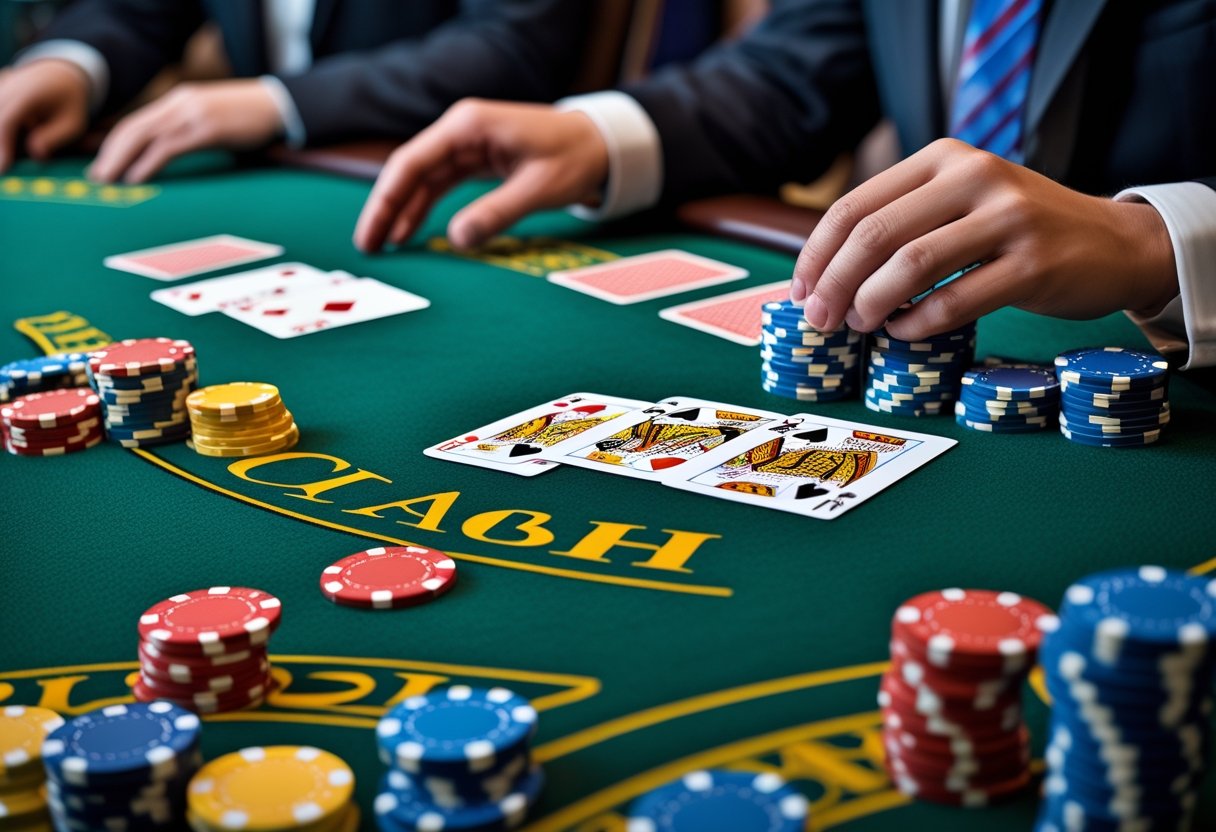
Blackjack Rules
Blackjack follows simple rules where players try to get cards totaling 21 without going over. The game uses standard card values and follows a set sequence where players make decisions before the dealer acts.
Objective of the Game
The goal in blackjack is to beat the dealer’s hand without exceeding 21 points. Players win by getting a hand total closer to 21 than the dealer’s hand.
If a player’s cards total more than 21, they bust and lose immediately. The dealer must also follow this rule.
Players can win in three ways:
- Get 21 or closer to 21 than the dealer
- Stay under 21 when the dealer busts
- Get blackjack (21 with first two cards) when the dealer doesn’t
A blackjack hand consists of an ace and a 10-value card. This pays 3:2 in most games instead of the standard 1:1 payout.
Card Values
Each card in blackjack has a specific point value that never changes during the hand.
| Card | Value |
|---|---|
| 2-9 | Face value |
| 10, J, Q, K | 10 points |
| Ace | 1 or 11 points |
Number cards (2 through 9) are worth their printed number. All face cards (Jack, Queen, King) count as 10 points.
Aces are special because they can count as either 1 or 11. The value that makes the best hand is used automatically.
When an ace counts as 11, the hand is called soft. When it counts as 1, the hand becomes hard.
Gameplay Sequence
Each blackjack round follows the same step-by-step process that determines winners and losers.
Initial Deal: Players place bets first. The dealer gives each player two cards face up and takes two cards with one face down.
Player Decisions: Starting from the dealer’s left, each player chooses their action:
- Hit: Take another card
- Stand: Keep current total
- Double: Double bet and take exactly one more card
- Split: Separate pairs into two hands
Players continue hitting until they stand or bust. Each player must finish before the next player acts.
Dealer Play: After all players finish, the dealer reveals the hidden card. The dealer must hit on 16 or less and stand on 17 or more.
Payouts: Players with higher totals than the dealer win even money. Blackjack pays 3:2.
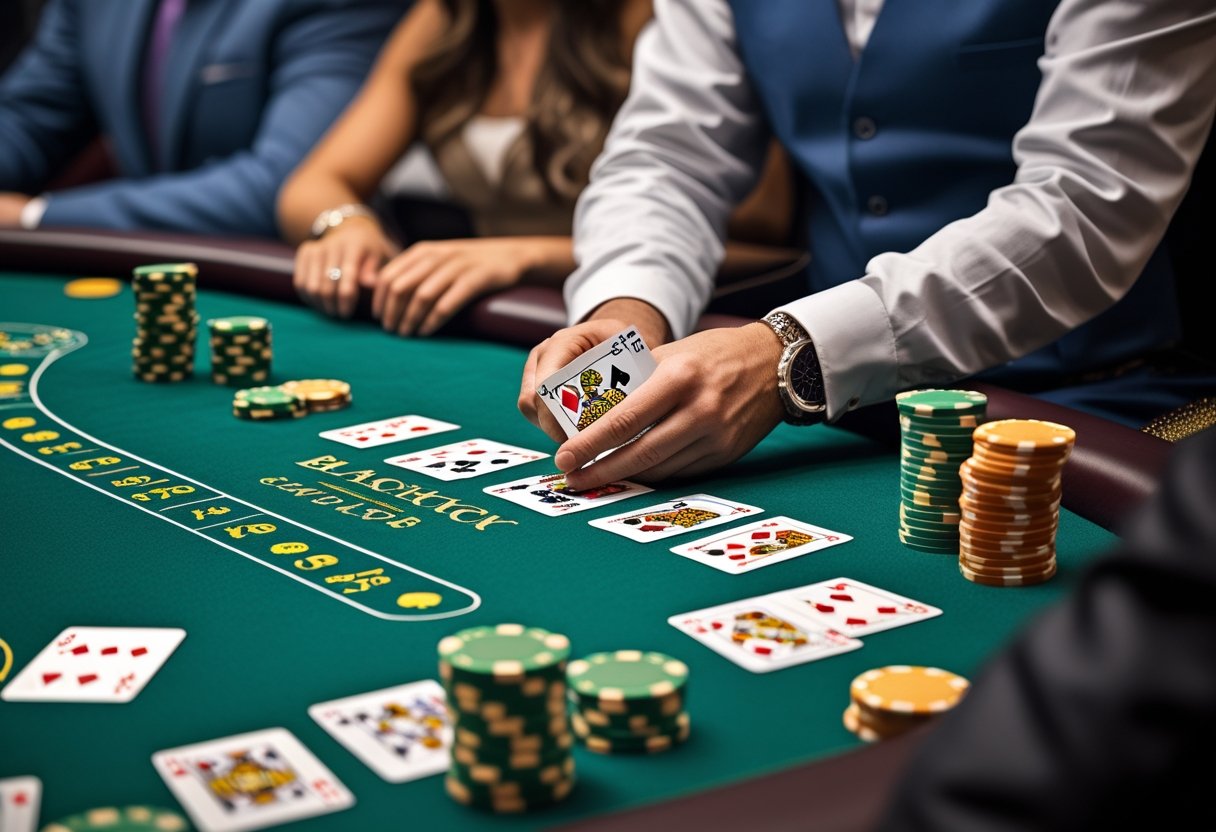
How to Play Blackjack
Blackjack follows a simple structure where players compete against the dealer to reach 21 without going over. The game involves specific setup requirements, player decision-making, and dealer rules that determine the outcome of each hand.
Setting up the Table
A standard blackjack table seats up to seven players. Each player receives two cards face up, while the dealer gets one card face up and one face down.
Card Values:
- Number cards (2-10): Face value
- Face cards (Jack, Queen, King): 10 points each
- Aces: 1 or 11 points (whichever helps the hand more)
Players place their bets in the designated betting circles before cards are dealt. The minimum and maximum bet limits are clearly posted at each table.
The dealer shuffles a standard 52-card deck or uses multiple decks from a shoe. Most casinos use six to eight decks to reduce card counting advantages.
Player Actions
Players have five main options after receiving their initial two cards. These decisions determine whether they improve their hand or risk busting.
Hit: Request another card to increase hand value. Players can hit multiple times until they reach 21 or bust.
Stand: Keep current hand total without taking additional cards.
Double Down: Double the original bet and receive exactly one more card. This option is only available on the first two cards.
Split: When dealt two identical cards, players can split them into separate hands. Each hand requires an additional bet equal to the original wager.
Surrender: Some tables allow players to forfeit half their bet and end the hand immediately.
Dealer Protocol
The dealer follows strict rules that never change based on player hands or table conditions. These automatic actions eliminate dealer decision-making.
The dealer must hit on hands totaling 16 or less. They must stand on all hands totaling 17 or higher, including soft 17s in most casinos.
After all players complete their actions, the dealer reveals their face-down card. They then hit or stand according to the house rules until reaching a final total.
Winning Conditions:
- Player gets 21 with first two cards (blackjack): Pays 3:2
- Player beats dealer without busting: Pays 1:1
- Player and dealer tie (push): Bet returned
- Player busts: Loses bet immediately
The dealer collects losing bets and pays winning hands before starting the next round.
Blackjack Strategies
Players can reduce the house edge to less than 1% by using proven mathematical strategies. The most effective approaches include following basic strategy charts, counting cards to track deck composition, and managing bankrolls through structured betting systems.
Basic Strategy
Basic strategy uses mathematics to determine the optimal play for every possible hand combination. These decisions are based on the player’s cards and the dealer’s visible card.
Strategy charts show exactly when to hit, stand, double down, or split. For example, players should always hit when holding 8 or less. They should stand on hard 17 or higher.
Soft hands contain an ace counted as 11. Players should double down on soft 13-18 when the dealer shows 5 or 6. This gives them the best chance to win.
Pair splitting requires specific rules. Always split aces and eights. Never split fives or tens. Split other pairs based on the dealer’s up card.
Players who memorize basic strategy reduce the house edge to approximately 0.5%. This makes blackjack one of the best casino games for players.
Card Counting
Card counting tracks which cards have been played to estimate remaining cards in the deck. The Hi-Lo system is the most popular method for beginners.
Players assign values to cards: +1 for 2-6, 0 for 7-9, and -1 for 10-Ace. They keep a running count as cards are dealt.
The true count divides the running count by estimated remaining decks. A positive true count means more high cards remain, favoring the player.
Players increase bets when the count is favorable and decrease them when it’s not. They also adjust basic strategy based on the count.
Casinos use multiple decks and shuffle frequently to combat counting. They may ask suspected counters to leave. Card counting requires significant practice and bankroll management.
Betting Systems
Betting systems help players manage their bankroll and control losses. These systems change bet sizes based on previous results.
The Martingale system doubles bets after losses and returns to base bet after wins. This system requires a large bankroll and has table limit risks.
Progressive systems like the 1-3-2-6 method increase bets during winning streaks. Players bet one unit, then three, then two, then six units in sequence.
Flat betting keeps the same bet size regardless of results. This approach provides steady, predictable play without large swings.
No betting system can overcome the house edge in the long term. They only change the pattern of wins and losses, not the overall mathematical outcome.
Blackjack Odds and Payouts
Blackjack offers some of the best odds in the casino with proper play, featuring a house edge as low as 0.5%. The standard 3:2 payout for natural blackjack provides the most favorable returns, while probability calculations show players can expect to win roughly 42% of hands.
House Edge
The house edge in blackjack varies significantly based on rules and strategy. With basic strategy, players face a house edge between 0.5% to 1% at most tables.
Several factors affect the house edge:
- Number of decks: Single deck games offer lower house edge
- Dealer rules: Dealer hitting on soft 17 increases house edge by 0.22%
- Doubling restrictions: Limited doubling options add to house edge
- Surrender rules: Late surrender reduces house edge by 0.07%
Poor playing decisions can increase the house edge to 2-4%. Players who avoid basic strategy give the casino a much larger advantage.
Payout Structures
Standard blackjack payouts determine how much players win on different hands. The most common payout structure pays 3:2 for natural blackjack.
Standard Payouts:
- Natural blackjack: 3:2 (bet $10, win $15)
- Regular wins: 1:1 (even money)
- Insurance: 2:1
Many casinos now offer 6:5 blackjack tables, which significantly reduce player returns. A $10 bet on natural blackjack pays only $12 instead of $15.
The 6:5 payout increases the house edge by approximately 1.4%. This makes the game much less favorable for players compared to traditional 3:2 tables.
Probability of Winning
Players can expect to win approximately 42% of blackjack hands, lose 49%, and push (tie) 9%. These percentages assume proper basic strategy play.
Key Probabilities:
- Natural blackjack: 4.8% chance
- Busting when hitting: Varies by hand total
- Dealer busting: 28% overall probability
The dealer busts more frequently when showing weak up cards. With a 5 or 6 showing, dealers bust about 42% of the time.
Players bust less often than dealers because they can choose when to hit or stand. This strategic advantage helps offset the dealer’s built-in edge of acting last.
Common Blackjack Terms
Players need to know four basic actions to play blackjack well. These moves let them make smart choices during each hand and control their risk at the table.
Hit and Stand
Hit means asking for another card from the dealer. Players tap the table or point at their cards to signal for a hit. They can keep hitting until they reach 21 or go over.
Players hit when their hand total is low. Most players hit on 11 or less because they cannot bust. They also hit on soft hands like Ace-6 because the Ace can change value.
Stand means keeping the current cards without taking more. Players wave their hand over their cards or say “stand” to signal this choice. Once they stand, their turn ends.
Players stand when they have a strong hand total. They usually stand on 17 or higher. Smart players also stand on 12-16 when the dealer shows a weak card like 4, 5, or 6.
Double Down
Double down lets players double their bet in exchange for exactly one more card. They must make this choice before taking any hits. The dealer gives them one card face down.
Players can only double down on their first two cards. Some casinos let players double on any two cards. Others only allow doubling on totals of 9, 10, or 11.
This move works best with strong starting hands. Players should double down on 11 against most dealer cards. They should also double on 10 when the dealer shows 9 or lower.
Doubling costs more money but can win bigger payouts. Players risk losing twice their original bet. But they also win twice as much when their hand beats the dealer.
Split
Split turns one hand with matching cards into two separate hands. Players must have two cards of the same value like 8-8 or King-Queen. They place a second bet equal to their first bet.
The dealer separates the cards and deals one new card to each hand. Players then play each hand normally. They can hit, stand, or double down on each split hand.
Some split rules help players:
- Most pairs can be split
- Players can split again if they get another matching card
- Split Aces usually get only one card each
Players should always split Aces and 8s. They should never split 10s, 5s, or 4s. Other pairs depend on what card the dealer shows.
Surrender
Surrender lets players give up their hand and get half their bet back. They must surrender before taking any other action. The dealer takes their cards and half their chips.
Not all casinos offer surrender. When available, players can surrender on their first two cards only. They cannot surrender after hitting, doubling, or splitting.
Early surrender happens before the dealer checks for blackjack. Late surrender happens after the dealer checks but has no blackjack. Late surrender is more common.
Players should surrender with very weak hands against strong dealer cards. Surrender 16 against a dealer 9, 10, or Ace. Also surrender 15 against a dealer 10. This saves money on hands that usually lose.
Online Blackjack
Online blackjack offers players three main ways to experience the game digitally. Live dealer versions provide real-time interaction with human dealers, mobile apps deliver portable gaming, and different online casinos vary in their rules and features.
Live Dealer Blackjack
Live dealer blackjack streams real games with human dealers through video technology. Players see actual cards being dealt from physical tables in studios or casinos.
Key Features:
- Real-time video streaming
- Chat function with dealers
- Multiple camera angles
- Authentic casino atmosphere
The dealer shuffles and deals physical cards while players make decisions through their computer or phone. This format combines online convenience with traditional casino elements.
Games typically run 24/7 with different betting limits. Stakes often range from $5 to $500 per hand depending on the table.
Players can interact with dealers through text chat. The social element makes live dealer games popular among those who miss casino interaction.
Mobile Blackjack Apps
Mobile blackjack apps let players access games on smartphones and tablets. Most online casinos offer dedicated apps or mobile-optimized websites.
Popular Platforms:
- DraftKings
- BetMGM
- FanDuel
Apps provide touch-screen controls for hitting, standing, and placing bets. Games load quickly and work on both iOS and Android devices.
Mobile versions often include the same features as desktop sites. Players can access multiple blackjack variations, bonuses, and account management tools.
Battery usage varies by app, but most modern phones handle several hours of gameplay. Internet connection affects game quality and loading speeds.
Online Casino Differences
Online casinos vary significantly in their blackjack offerings and rules. These differences affect player odds and gaming experience.
Common Variations:
- Number of decks used
- Dealer soft 17 rules
- Doubling down restrictions
- Surrender options available
Some sites offer European Blackjack where dealers don’t check for blackjack immediately. Others feature Atlantic City rules with late surrender options.
Bonus structures differ between casinos. Some provide welcome bonuses that apply to blackjack, while others exclude table games from bonus play.
Payment methods and withdrawal speeds vary significantly. Processing times range from instant to several business days depending on the chosen method.
Responsible Gaming in Blackjack
Smart blackjack players protect themselves by managing their money carefully and knowing when to stop. Setting clear spending and time limits before playing helps prevent losses from getting out of control.
Bankroll Management
Players should never gamble with money they cannot afford to lose. This means using only extra money after paying for housing, food, bills, and savings.
A good rule is to risk no more than 1-5% of total gambling money on each hand. For example, someone with a $200 bankroll should bet between $2-10 per hand.
Daily bankroll tips:
- Divide total gambling money into smaller daily amounts
- Stop playing when the daily amount is gone
- Never borrow money to continue playing
- Keep gambling money separate from bill money
Players should track their wins and losses over time. This helps them see if they are spending too much or playing too often.
Setting Limits
Time limits prevent players from making bad choices when tired or frustrated. Many players set alarms or use phone reminders to stop after 1-2 hours.
Effective limit strategies:
- Set a loss limit before starting (like $50 maximum loss)
- Choose a win goal and stop when reached
- Take breaks every 30-45 minutes
- Never chase losses by betting more money
Most online casinos offer tools to help players stick to their limits. These include deposit limits, session timers, and reality check pop-ups that show how long someone has been playing.
Players should set these limits when thinking clearly, not during or after playing. Changing limits should require a 24-hour waiting period.
Responsible Gambling Resources
Players who struggle to control their gambling can get free help from several organizations. The National Council on Problem Gambling offers a helpline at 1-800-522-4700.
Support options include:
- Gamblers Anonymous: Free support group meetings
- Self-exclusion programs: Block access to casinos and websites
- Counseling services: Professional help for gambling problems
- Family support groups: Help for loved ones affected by gambling
Many states have their own problem gambling websites with local resources. These sites often include free assessment tools to help people understand if their gambling is becoming a problem.
Online casinos are required to provide links to these resources and allow players to set cooling-off periods or permanently close their accounts.
Blackjack Etiquette
Following proper etiquette at the blackjack table shows respect for other players and dealers. Good table manners help create a pleasant atmosphere, while appropriate tipping recognizes the dealer’s service.
Table Manners
Players should wait for the current hand to finish before joining a table. This prevents confusion and shows respect for ongoing play.
Hand signals are required for all decisions. Players tap the table to hit and wave their hand to stand. These clear signals help the dealer and security cameras track the game properly.
Players must avoid touching their cards in shoe games. The dealer handles all card movement in these games. Only touch cards when playing single or double-deck games where cards are dealt face down.
Chip handling follows specific rules:
- Place bets before cards are dealt
- Stack chips in neat piles with highest values on bottom
- Never touch chips once the hand begins
- Keep chips visible to the dealer at all times
Players should make decisions quickly without slowing down the game. Taking too long frustrates other players and dealers.
Cell phone use should be minimal during play. Many casinos prohibit phone calls at the table. Players can check messages between hands but should not delay the game.
Tipping the Dealer
Tipping dealers is expected but not required. Most players tip when they win or leave the table with profits.
Common tipping methods include:
- Placing a bet for the dealer alongside your own bet
- Handing chips directly to the dealer after winning
- Leaving a tip when departing the table
Players typically tip $1-5 per hour of play at lower limit tables. Higher stakes players often tip more based on their bet size and winnings.
The best time to tip is after winning a good hand or blackjack. Players can also tip when the dealer provides helpful service or maintains a friendly atmosphere.
Some players make side bets for the dealer on hands they feel confident about. If the hand wins, both player and dealer benefit from the outcome.
Famous Blackjack Players
Several players have become legends in the blackjack world. These skilled individuals changed how people think about the game.
Edward Thorp is often called the father of card counting. He wrote the famous book “Beat the Dealer” in 1962. This book showed players how to use math to win at blackjack.
Ken Uston was another famous card counter. He led blackjack teams in the 1970s and 1980s. Uston won millions of dollars from casinos using team strategies.
The MIT Blackjack Team became very famous in the 1990s. This group of college students used card counting to win huge amounts. They worked together as a team to beat casinos.
Stanford Wong created new card counting methods. He wrote many books about blackjack strategy. Wong also developed the practice of “Wonging” – watching games before joining.
Tommy Hyland has led blackjack teams for over 30 years. His teams have won millions from casinos worldwide. Hyland is known for his careful team management.
Al Francesco invented the “Big Player” strategy. This method uses team members to count cards and signal a big bettor. Many modern blackjack teams still use his ideas.
These players proved that blackjack can be beaten with skill and strategy. They turned the game from pure luck into a battle of minds against the house.
Blackjack Tournaments
Blackjack tournaments offer players a chance to compete against others instead of just the dealer. Players start with the same number of chips and play for a set time or number of hands.
The goal is simple. Finish with more chips than other players at your table.
Tournament Structure
Most tournaments use an elimination format. Players advance through multiple rounds until only the winners remain.
Entry fees vary widely. Some tournaments are free while others cost hundreds or thousands of dollars to enter.
Key Differences from Regular Play
Tournament strategy differs from regular blackjack. Players must consider their chip position compared to opponents.
Sometimes the best move is to bet big when behind. Other times, small bets help protect a lead.
Types of Tournaments
| Format | Description |
|---|---|
| Elimination | Players advance through rounds |
| Accumulation | Total chips over multiple sessions |
| Sit-and-go | Starts when table fills up |
Where to Play
Land-based casinos host major tournaments with large prize pools. Online casinos also offer daily and weekly events.
Some tournaments require no deposit to enter. Others charge entry fees but offer bigger prizes.
Prize Structure
Winners typically receive cash prizes. The largest tournaments can award six-figure amounts to champions.
Most tournaments pay multiple places. Even finishing in the top half often means winning money.
Technology and Blackjack
Modern technology has transformed how players approach blackjack through artificial intelligence tools and sophisticated analysis software. These digital advances help players make better decisions and understand the game at deeper levels.
AI and Blackjack
Artificial intelligence now powers many aspects of blackjack gaming. Online casinos use AI algorithms to create more realistic dealer behavior and detect unusual betting patterns.
Players can access AI-powered apps that teach basic strategy. These programs analyze millions of hands to show the mathematically correct decision for any situation.
Machine learning systems study player behavior to identify counting techniques. Casinos use this technology to spot advantage players more quickly than human surveillance.
AI also drives random number generators in online blackjack games. These systems ensure fair card distribution by simulating real shuffling patterns.
Some AI tools can analyze live dealer games through video feeds. However, most reputable casinos prohibit using such software during play.
Software for Analysis
Card counting software helps players practice their skills away from the casino floor. Programs like Casino Verite simulate real game conditions with multiple deck variations.
Blackjack trainers quiz players on basic strategy decisions. These apps track accuracy rates and highlight common mistakes.
Professional players use bankroll management software to track wins and losses. These programs calculate optimal bet sizing based on current funds and risk tolerance.
Simulation software runs millions of hands to test different strategies. Players can input house rules and see how various approaches affect long-term results.
Some programs analyze shuffle patterns in live games. However, modern shuffling machines make this type of analysis less effective than in the past.
Frequently Asked Questions
New blackjack players often wonder about playing for free, understanding basic rules, and finding real money games. Players also want to know about winning strategies, game variations, and how casinos calculate their mathematical advantage.
How do you play Blackjack online for free?
Most online casinos offer free blackjack games through their websites. Players can access these games without creating an account or downloading software.
Free games use virtual chips instead of real money. This allows beginners to practice basic strategy and learn the rules without financial risk.
Many casino websites have a “play for fun” or “demo mode” option. Players click this button to start playing immediately with fake money.
What are the basic rules of Blackjack for beginners?
The goal is to beat the dealer’s hand without going over 21. Players win by having a higher hand value than the dealer or when the dealer busts.
Card values are simple to learn. Number cards equal their face value, face cards equal 10, and aces equal either 1 or 11.
Players receive two cards and can choose to hit for more cards or stand with their current total. The dealer follows strict rules about when to hit or stand.
Going over 21 is called “busting” and results in an automatic loss. A blackjack is an ace plus a 10-value card, which typically pays 3 to 2.
Can Blackjack be played online for real money?
Yes, many licensed online casinos offer real money blackjack games. Players must create accounts and deposit funds to participate.
Legal online casinos operate in many states and countries. Players should verify that their chosen casino has proper licensing and regulation.
Most casinos accept credit cards, bank transfers, and digital wallets for deposits. Withdrawal options vary by casino but usually include the same methods used for deposits.
What strategies can increase your odds of winning at Blackjack?
Basic strategy is the most important skill to learn. This involves knowing the mathematically correct decision for every possible hand combination.
Basic strategy charts show when to hit, stand, double down, or split pairs. Following these charts reduces the house edge to less than 1%.
Players should avoid insurance bets and side bets. These options typically have much higher house edges than the main blackjack game.
Money management is also crucial. Players should set loss limits and never bet more than they can afford to lose.
Are there any variations of Blackjack with different rules than the classic version?
European Blackjack uses two decks and the dealer doesn’t peek for blackjack. This changes the strategy for doubling down and splitting pairs.
Spanish 21 removes all 10s from the deck but offers bonus payouts for special hands. Players can also surrender after doubling down.
Blackjack Switch allows players to play two hands and switch the top cards between them. This variation has different payout rules to compensate for the advantage.
Double Exposure shows both dealer cards face up. However, dealer wins all ties except blackjack to balance the game.
How is the house edge calculated in Blackjack?
The house edge represents the casino’s mathematical advantage over players. It shows the expected loss per dollar bet over the long term.
Basic blackjack has a house edge of about 0.5% when players use perfect basic strategy. This means the casino expects to keep 50 cents from every $100 wagered.
Different rules affect the house edge. Dealer hitting on soft 17 increases it by 0.22%, while early surrender decreases it by 0.39%.
The number of decks also matters. Single deck games have lower house edges than games using six or eight decks.