
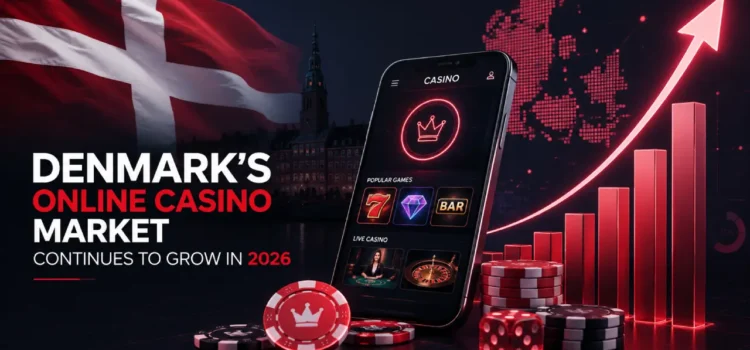
Denmark has quietly become one of Europe’s most interesting iGaming stories. What used to be a lottery-dominated gambling landscape has flipped in just a few years, and by 2026 the online casino sector is no longer the challenger. It is the main event. Operators, regulators and players are all moving in ways that reinforce the same conclusion: Danish online gambling is not just healthy, it is expanding into new territory even as the wider market shows signs of maturity.
From Challenger to Category Leader
For years, lotteries sat at the top of Denmark’s gambling pyramid, mostly thanks to the historical monopoly enjoyed by Danske Spil. That order has been rewritten. According to the Danish Gambling Authority’s annual review, online casino gaming was responsible for 38% of total gross gaming revenue, with revenues climbing 12.1% to 4.31 billion DKK, while lottery revenues fell more than 6% to just under 3.5 billion DKK. That crossover marks a genuine turning point in a jurisdiction that has been regulated since 2012.
The wider Danish gambling market brought in a gross gaming revenue of roughly 11.5 billion DKK in 2025, slightly below the previous year. But that flat headline hides a very active shift beneath the surface. Land-based venues are shrinking, betting is roughly flat, and online casinos are absorbing the demand.
The Numbers Behind Denmark’s iGaming Momentum in 2026
Monthly reporting throughout 2026 has continued the story. Data released by Spillemyndigheden for April 2026 showed players spent DKK 680m in total, a 2.3% year-on-year increase, with online gambling coming in at DKK 392m, an 18.4% jump and the biggest year-on-year growth of any vertical. Land-based casinos, in contrast, contracted by more than 8% year-on-year, generating only around DKK 28m for the same month.
The table below summarises how Denmark’s gambling revenue split looked heading into 2026, based on the regulator’s 2025 figures.
| Vertical | 2025 GGR (DKK) | Market Share | Year-on-Year Change |
|---|---|---|---|
| Online casino | 4.31 billion | 38% | +12.1% |
| Lotteries | 3.49 billion | 30% | −6.2% |
| Sports betting | ~2.1 billion | ~18% | Slight decline |
| Slot & gaming machines | ~1.2 billion | ~10% | Modest |
| Land-based casinos | 378 million | ~3% | −5.6% |
| Total market | 11.5 billion | 100% | −1% |
The trajectory is unmistakable. Online casino is the only major vertical that consistently grows in double digits while everything else either flattens or contracts. Detailed monthly commentary and operator-level analysis is tracked closely by resources such as huskyspace dk, which have followed the shift as it unfolded.
What Is Actually Driving the Growth
The rise did not happen by accident. Several intersecting forces have made 2026 a strong year for Danish online casinos, and they are worth pulling apart individually.
Mobile-First Player Behaviour
Danish players spend most of their casino time on smartphones. Operators have responded by rebuilding lobbies for touch, cutting page-load times, and pushing app-style navigation into the browser. The result is that the online experience has become materially better than what land-based venues can offer for casual sessions, which erodes the case for driving to a physical casino for anything other than an event night out.
Live Dealer Enters the Mainstream
Denmark’s love affair with live dealer content is one of the country’s defining traits. Danish-speaking tables are now expected rather than a bonus, and studios like Evolution, Pragmatic Play Live and Ezugi have all pushed further into local-language broadcasts. Players seem to genuinely enjoy the sociability of live rooms, which explains why the format keeps growing even as competing sectors decline. Live casino is also profitable for operators, so the incentives are aligned on both sides.
A Slot-Centric Economy
Denmark has become one of the most slot-heavy markets in Europe. Recent commercial data suggests nearly 85% of genre demand belongs to slots, an extraordinary concentration that makes Denmark deeply slot-centric. Live casino sits at roughly 8%, crash games are still niche but growing on the back of titles like Aviator and Chicken Road, and everything else scraps for the remainder. This is why any provider serious about the Danish market must lead with slot distribution.
The Competitive Landscape Is Shifting
At the operator level, the story is not simply about the incumbent holding its ground. Danske Spil remains a strong leader because of decades of consumer trust and its state-backed heritage, but the challengers are the ones creating the more interesting headlines. Recent commercial data has highlighted Bet365’s near 40% year-on-year growth and Betano’s staggering surge north of 150%, while older brands such as Mr Green, Tivoli Casino and ComeOn have shown contraction. Mature markets, in other words, do not automatically protect the operators already inside them.
The table below captures the tone of the competitive movement heading into 2026.
| Operator | Position | Trajectory |
|---|---|---|
| Danske Spil | Market leader (~25% estimated share) | Stable |
| Bet365 | Established international | Strong growth (~40% YoY) |
| Betano (Kaizen) | Rising challenger | Explosive growth (~157% YoY) |
| Mr Green | Legacy brand | Contracting |
| Tivoli Casino | Local brand | Contracting |
| ComeOn | Multi-brand operator | Contracting |
Two takeaways stand out. First, well-funded international brands with modern product stacks are still able to take share from long-established local names. Second, being Danish in origin is no longer sufficient protection if the product experience does not keep up.
Regulatory Confidence as a Growth Engine
Denmark’s regulator, Spillemyndigheden, is often held up as an example of how careful licensing can attract growth rather than restrict it. The 2025 annual report highlighted a channelisation rate above 91%, placing Denmark among the top five regulated online gambling markets globally. That is a remarkable figure and it speaks to two things at once: operators find the Danish licence commercially viable, and players find the licensed environment attractive enough to stay inside it.
By the close of 2025, Spillemyndigheden had issued close to 2,000 licences across all gambling categories, which reflects a mature ecosystem with a wide supplier base. A separate certification regime for game suppliers, in force since January 2025, has added another layer of accountability by requiring suppliers to hold their own licence to serve Danish operators. That change has quietly pushed product quality upward across the board.
Consumer Protection Working in Tandem With Growth
One of the more interesting aspects of the Danish story is how growth has coexisted with stronger consumer protections. The country’s ROFUS self-exclusion register has become part of the mainstream conversation about safer gambling, and its scale is meaningful. By the end of 2025, more than 68,000 Danes had registered with the self-exclusion system. That figure would look alarming in isolation, but in context it demonstrates that the tools work and that Danish players are using them. It also shows why regulators in other jurisdictions frequently look to Copenhagen when designing their own frameworks.
Interestingly, the average gambling spend per adult decreased to roughly 2,356 kroner in 2025, which suggests spending per player is falling even as the online sector grows. That combination is a signal of a healthier market rather than a runaway one, which is the outcome regulators tend to want.
The 2026 Licensing Reset
A significant development landed in the summer of 2026 when Spillemyndigheden reopened the land-based casino licensing window. Applications must be submitted in full by early November 2026 under the updated Consolidation Act, and the regulator can issue permits valid for up to ten years. Fees scale to revenue, with licence holders in 2026 paying annual amounts that range from just under DKK 200,000 for smaller operators to more than DKK 1.6 million for those bringing in revenue above DKK 100 million.
While this specific window applies to land-based venues, its symbolism matters for the online side too. The Danish authority is signalling openness to new entrants, careful vetting of ownership structures, and continued professionalisation of the industry. Operators watching Denmark from outside can take confidence that the regulatory door is not closed.
At the same time, from 2026 onwards, recertification for online operators is triggered by changes that affect compliance rather than an automatic annual cycle. That shift lets compliant operators focus resources on innovation instead of routine paperwork, which further encourages product investment.
Payment Habits and Player Preferences
Denmark’s payment culture is another quiet driver behind online casino growth. Danish players are comfortable with cards, e-wallets and account-to-account services like Trustly, all of which reduce friction at deposit and withdrawal. Fast payouts are effectively table stakes now, and any operator that takes too long to release funds finds itself losing loyalty to a competitor that will not.
Here is a snapshot of how Danish player preferences typically break down at licensed sites.
| Preference Area | Danish Player Norm |
|---|---|
| Preferred device | Smartphone (dominant) |
| Preferred games | Slots (~85% of demand) |
| Second-favourite category | Live dealer (~8%) |
| Payment types | Cards, e-wallets, Trustly, MobilePay |
| Withdrawal expectation | Same-day to 24 hours |
| Language expectation | Danish interface and Danish-speaking dealers |
The message for operators is that surface-level localisation is no longer enough. Danish players expect the whole product to feel native, from the copy in the lobby to the voice on the live table.
The Content Race Between Providers
Provider competition inside Denmark has become sharper. Pragmatic Play is currently the country’s most popular slots and live dealer producer, with Nordic-adjacent names like Elk Studios also holding strong positions. Titles that resonate globally, including Book of Dead, Gates of Olympus, Sweet Bonanza and Big Bass Bonanza, dominate Danish lobbies, but so do newer high-volatility and crash-style games that reflect changing tastes.
The interesting sub-plot is how quickly Danes adopt new content. When a hit slot launches, it appears in Danish lobbies almost immediately, and marketing calendars build around new releases the way music labels used to build around single drops. That responsiveness benefits both providers and operators because it keeps players inside licensed channels rather than drifting to grey-market alternatives.
Outlook for the Rest of 2026 and Beyond
Looking ahead, the trend lines do not suggest a sudden reversal. Analysts continue to expect steady expansion, with longer-term modelling pointing to a Danish online casino market that keeps ticking upward on a compound basis through the end of the decade. User penetration is expected to keep rising from around 9% toward the low double digits over the next few years, and monthly data has already run ahead of conservative baseline forecasts in several stretches of 2025 and 2026.
Three developments to watch through the rest of 2026:
The first is how Betano and other fast-growing challengers convert momentum into sustained share. High growth from a smaller base is one thing, but holding those players and improving unit economics is what determines longer-term winners.
The second is the interplay between land-based licensing and online product roadmaps. Operators that hold both types of licence will be able to design cross-channel loyalty schemes in a way pure online brands cannot easily match.
The third is anti-money-laundering enforcement. Spillemyndigheden’s revised Anti-Money Laundering Guidance, published in early 2026, tightens expectations around risk assessment and customer due diligence, and operators that invest early in compliance infrastructure will be better positioned as European AMLA rules take shape.
The Broader Significance
Denmark’s story in 2026 matters beyond its own borders. It shows what a well-regulated, medium-sized European market can look like when licensing is credible, consumer protection is genuine and product quality is competitive. Growth here is not being fuelled by aggressive marketing or loose oversight. It is being fuelled by trust, better products, and the fact that Danish players simply enjoy online casino play more than they enjoy the alternatives on offer.
For operators, the lesson is that entering Denmark on the back of a generic international product will not work. Localisation, live dealer investment, slot content leadership and payment fluency are the entry ticket. For players, the market keeps improving because competition is intense and the regulator refuses to let quality drift. For regulators elsewhere in Europe, Denmark remains a case study in how to make channelisation actually stick.
The online casino sector in Denmark did not simply grow in 2026. It became the centre of gravity for the entire gambling industry in the country, and there is very little in the current data to suggest that will change anytime soon.